
Sitting down to meditate sounds simple until you actually try to do it.
You close your eyes, take three deep breaths, and immediately your brain starts cycling through unread emails, half-remembered conversations, and what to make for dinner.
That mental restlessness is completely normal, but it is also the main reason so many people abandon meditation within their first week.
Having something tactile to anchor your awareness transforms that struggle.
Holding a strand of beads gives your hands a quiet task, gives your mind a steady rhythm, and turns a vague intention into a physical, grounding practice you can actually look forward to each day.
What Are Mala Beads and Why Do They Work?
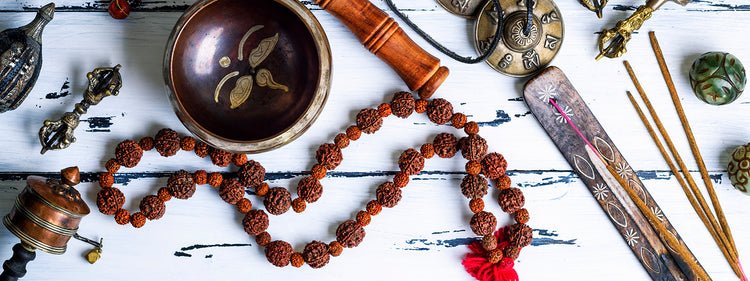
Mala beads have served as contemplative tools across spiritual traditions for thousands of years, most notably in Hindu, Buddhist, and yogic lineages.
A traditional full mala consists of 108 counter beads, plus a larger “guru bead” or tassel that marks the beginning and conclusion of a cycle.
Why 108? Ancient scholars attached countless symbolic meanings to the number, from astronomy to energetic meridians in the human body, but in daily practice, 108 serves a very practical purpose: it is long enough to let your nervous system downshift, yet short enough to fit into a morning routine before work.
From a modern psychological angle, mala beads function through sensory anchoring.
When you pair a deliberate physical movement—touching a textured bead between your thumb and finger—with a breath or a spoken phrase, your nervous system receives tangible feedback.
Instead of trying to force your mind into total emptiness, you give it a clear, rhythmic focal point.
Over time, your body builds a conditioned reflex: the moment your fingers meet the beads, your heart rate steadies and your awareness settles.
Choosing Between a Full Mala and a Mala Bracelet
If you are establishing a daily habit, the first decision is finding an instrument that suits your real lifestyle, not an idealized version of it.
A traditional 108-bead necklace provides a deep, dedicated sit.
Because of its length, it encourages you to carve out fifteen to twenty minutes of quiet immersion, making it ideal for altar spaces, home meditation corners, or dedicated morning sits.
However, you do not always need a full strand to tap into this grounded state.
A mala bracelet—often strung with 18, 21, or 27 beads—offers the exact same rhythmic support in a compact, portable format.
If your routine involves meditating on a park bench during your lunch break, practicing breathwork on the subway, or doing three quick cycles at your desk between meetings, a wrist mala keeps your practice within arm’s reach.
Many practitioners actually use both: a full mala resting at home for sunrise sits, and a comfortable mala bracelet worn throughout the day to recall that stillness whenever friction arises.
Preparing Your Mind and Space Before Sitting
Meditation does not require special incense or expensive floor cushions, but setting the stage makes consistency far easier.
Find a spot where you can sit undisturbed for at least ten minutes.
You can sit cross-legged on a firm pillow, or sit upright in a sturdy chair with your feet flat on the floor.
What matters most is a spine that feels tall without being rigid.
Hold your beads in your lap for a moment before beginning.
Take three slow, unhurried breaths in through your nose and out through your mouth.
Notice the weight of the beads in your palm, the natural coolness of the seeds, stones, or wood, and acknowledge whatever mood you brought to the cushion today.
You do not need to fix your emotions or clear your mind before starting; you simply bring everything you are feeling into the practice.
Step-by-Step: How to Meditate with Mala Beads
Using a mala is deeply intuitive once your fingers learn the movement. Here is how to navigate a traditional cycle step-by-step:
- Hold the mala in your right hand: In classical tradition, the right hand is used for spiritual practice. Drape the strand gently over your middle or ring finger, using your thumb to roll each bead toward you. Avoid using your index finger if possible, as traditional yogic philosophy associates the pointer finger with the ego.
- Start at the guru bead: Locate the larger anchor bead, usually marked with a tassel. Place your thumb on the very first bead sitting next to it. Do not count the guru bead itself as one of the 108 repetitions; it functions as your starting line and your resting place.
- Pair each bead with a breath or mantra: With your thumb resting on the first bead, inhale and exhale fully, or recite your chosen word. Once complete, use your thumb to roll the next bead into place and repeat.
- Keep the pace natural: Do not rush through the beads to finish quickly, and do not force an artificially slow cadence. Follow the natural current of your breath. If your mind wanders—and it will—gently notice the distraction, feel the bead under your thumb, and resume.
- Respect the guru bead: When you complete the circuit and arrive back at the guru bead, pause in gratitude. If you want to do a second round of meditation, traditional etiquette suggests not jumping over the guru bead. Instead, flip the entire strand in your fingers and travel back in the opposite direction.
Selecting a Meaningful Word or Mantra
The beads provide the rhythm, but your mantra gives the practice direction.
A mantra does not have to be an esoteric Sanskrit phrase unless that resonates with you. It can be as simple as an English affirmation, a spiritual prayer, or basic breath awareness.
If you prefer traditional Sanskrit phrases, “Om Shanti” (peace) or “So Hum” (I am that) offer soothing vocal resonances that settle the chest and throat.
If you prefer plain language, choose an intentional phrase that addresses where you currently feel depleted.
Repeating words like “I am present,” “Release,” or “Steady and grounded” with every movement of the beads can gently rewire an agitated thought pattern.
If words feel too loud for your quiet morning, you can simply sync each bead with one conscious inhale and exhale.
Wearing Your Beads Outside of Meditation
One of the quiet joys of working with tactile tools is that their purpose does not end when you stand up from your cushion.
Wearing your beads throughout the day bridges the gap between seated stillness and the chaos of everyday obligations.
Whenever you catch yourself clenching your jaw, waiting in traffic, or feeling overwhelmed by a deadline, you can gently touch your necklace or the beads of your mala bracelet.
That physical texture acts as an immediate sensory cue, reminding your body of the grounded presence you cultivated that morning.
In this way, your beads transition from a formal ritual instrument into an ongoing companion for mindful living.
Conclusion
Learning how to weave mala beads into your daily routine is less about mastering rigid rules and far more about building a dependable sanctuary for your thoughts.
You do not need an hour of uninterrupted silence, nor do you need an empty mind to reap the benefits. Start small.
Commit to one quiet round of 108 breaths in the morning, or slide on a mala bracelet and count twenty-one gentle affirmations when you wake up.
Let the smooth repetition of the beads steady your hands, soften your breathing, and bring you back home to yourself, one bead at a time.